
Miswāk: One of the Final Sunnahs of the Prophet ﷺ
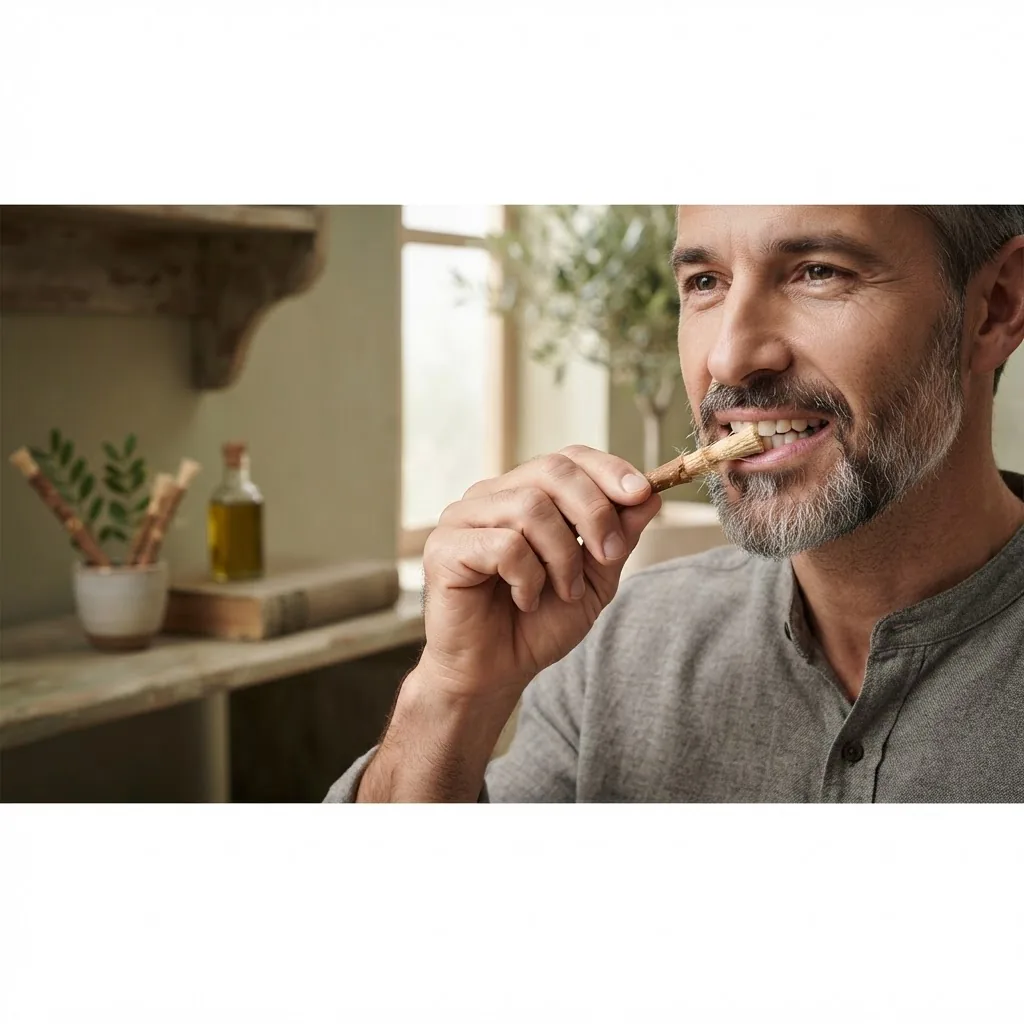
Rediscovering a Prophetic Practice Through the Lens of Modern Science
There are moments in history that leave a lasting impression on the heart.
Among the final moments of the life of our beloved Prophet Muhammad ﷺ is one that is both deeply moving and profoundly practical.
As he lay in the illness from which he would return to his Lord, ʿĀ'ishah (رضي الله عنها) noticed him looking towards a miswāk that her brother, ʿAbd al-Raḥmān ibn Abī Bakr (رضي الله عنه), was carrying. Recognising what he desired, she took the miswāk, softened its fibres, and placed it into the blessed hand of the Messenger of Allah ﷺ.
He cleaned his teeth with it carefully and thoroughly.
Shortly afterwards, with his head resting against the chest of ʿĀ'ishah (رضي الله عنها), he returned to Allah.
Among the final physical actions of the Messenger of Allah ﷺ before leaving this world was the use of the miswāk.
Pause and reflect on that for a moment.
If you knew you were about to meet your Lord, what would be among your final actions?
The Prophet ﷺ chose to cleanse his mouth.
That alone should make every Muslim pause and appreciate the importance he placed upon oral cleanliness.
Yet this was not an isolated event.
Throughout his life, the Prophet ﷺ repeatedly encouraged the use of the miswāk.
He said:
"Were it not that I would make things difficult for my Ummah, I would have commanded them to use the miswāk before every prayer."
— Ṣaḥīḥ al-Bukhārī (887); Ṣaḥīḥ Muslim (252)
In another authentic narration he said:
"The miswāk is a means of purifying the mouth and pleasing the Lord."
— Sunan al-Nasāʾī
Notice the order.
The Prophet ﷺ did not say it whitens the teeth.
He did not say it prevents gum disease.
He did not say it reduces plaque.
He first connected the miswāk to something far greater:
"…and pleasing the Lord."
For the believer, this is the greatest benefit.
Everything else is an added blessing.
Modern Science Catches Up
Over the past two decades, researchers have developed a growing interest in Salvadora persica, the tree from which the traditional miswāk is obtained.
Numerous laboratory studies, clinical trials and systematic reviews have demonstrated that, when used correctly, miswāk can:
- reduce dental plaque;
- improve gum health;
- reduce gingival bleeding;
- inhibit the growth of several harmful oral bacteria;
- freshen the breath;
- stimulate saliva production.
Several systematic reviews have even suggested that miswāk may achieve plaque control comparable to conventional toothbrushes when proper technique is used, although the best evidence supports using it alongside brushing with fluoride toothpaste rather than replacing modern dental care altogether.
The Prophet ﷺ taught us to clean our mouths over fourteen centuries ago.
Modern dentistry is now helping us understand some of the wisdom behind that practice.
The Mouth: The Gateway to Health
For many years, oral health was considered separate from the rest of the body.
Today we know that this is not the case.
The mouth is home to one of the most diverse microbial communities in the human body.
Healthy gums help maintain a healthy balance of bacteria.
When plaque accumulates, inflammation develops. Over time this may progress to periodontal disease—a chronic inflammatory condition affecting the tissues supporting the teeth.
Research has linked poor periodontal health with numerous systemic diseases, including:
- Diabetes mellitus
- Cardiovascular disease
- Stroke
- Aspiration pneumonia in frail older adults
- Adverse pregnancy outcomes
- Cognitive decline
Although these associations do not necessarily prove causation, they remind us that caring for the mouth is an important part of caring for the whole person.
Good oral health also enables us to eat nutritious foods comfortably, speak confidently, smile freely and maintain social interaction throughout life.
The Prophet ﷺ taught us to care for our mouths long before medicine appreciated just how closely oral health and general health are connected.
A Sunnah Designed Around Daily Life
Perhaps one of the greatest strengths of the miswāk is not simply what it is—but how easily it becomes part of everyday life.
Unlike a toothbrush, which usually remains in the bathroom, the miswāk is portable.
It can accompany you throughout the day.
Behavioural science teaches us that habits become stronger when they are attached to existing routines.
The five daily prayers provide exactly that structure.
Imagine if every Muslim kept a miswāk:
- in their pocket;
- beside the front door;
- in the car;
- near the wuḍūʾ area;
- beside their prayer mat.
Each prayer becomes a reminder.
Each reminder strengthens the habit.
Each use becomes an act of worship.
Rather than relying on motivation, the environment itself begins to encourage the Sunnah.
Practical Steps to Revive the Miswāk
Reviving this beautiful Sunnah need not be complicated.
Try one or more of the following:
- Carry a miswāk in a protective case in your pocket.
- Keep one beside your keys near the front door.
- Place one in the car for use before entering work or the masjid.
- Keep one near your wuḍūʾ area so it becomes part of your preparation for prayer.
- Where appropriate according to your madhhab, keep one beside your prayer mat and use it before ṣalāh.
- Replace the fibres regularly and store it in a clean, ventilated holder.
- Use gentle strokes, cleaning every surface of the teeth rather than scrubbing aggressively.
Do not think of the miswāk as replacing modern dentistry.
Think of it as reviving a Sunnah while embracing the best available evidence in preventive oral healthcare.
Reflection
The Prophet ﷺ did not use the miswāk because it reduced plaque.
He used it because it was pleasing to Allah.
Today, science helps us appreciate some of the wisdom contained within that practice.
It reminds us that the Sunnah is not merely a collection of rituals. It is a way of living that nurtures the body, refines the character and prepares the soul to meet its Lord.
Perhaps that is why, among the final physical actions of the Messenger of Allah ﷺ before returning to Allah, was to cleanse his blessed mouth with the miswāk.
May Allah grant us the ability to revive this beautiful Sunnah with sincerity, consistency and love, and may He make every small act performed in imitation of His beloved Messenger ﷺ a means of drawing us nearer to Him.
Āmīn.