
Gratitude: Where Modern Psychology Meets an Ancient Islamic Worldview
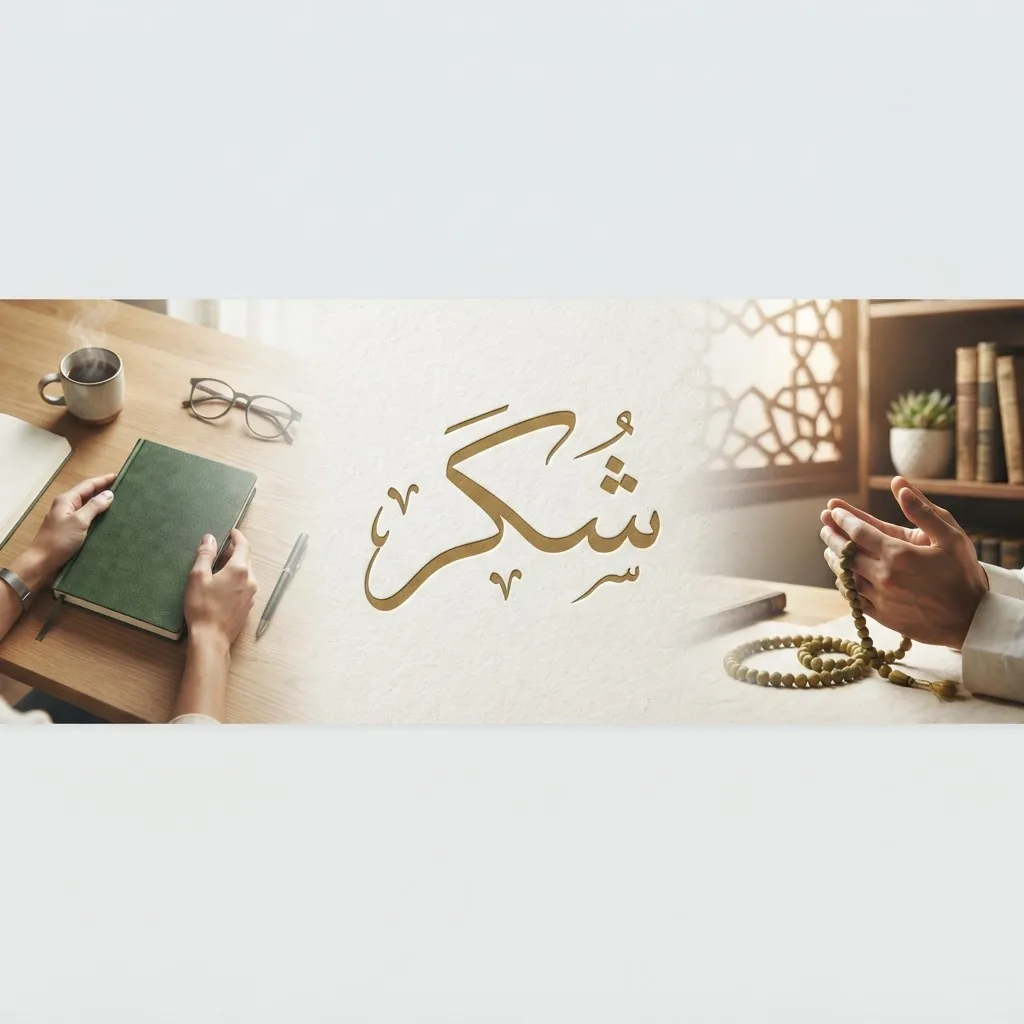
As healthcare professionals, we are becoming increasingly aware of the growing body of research exploring the relationship between gratitude and wellbeing. Patients are encouraged to keep gratitude journals, reflect on positive experiences and consciously recognise the good in their lives. These simple practices have been associated with improvements in mood, resilience, optimism, sleep quality and overall wellbeing.
The evidence is compelling.
Studies suggest that people who regularly practise gratitude report lower levels of depression, greater life satisfaction and stronger social relationships. Gratitude appears to shift attention away from problems and towards blessings, helping people interpret life's challenges through a more hopeful lens.
From the perspective of modern psychology, gratitude is often understood as a cognitive skill. It is a way of training the mind to notice positive experiences rather than dwelling exclusively on difficulties.
Islam certainly agrees with these observations.
However, it also asks a deeper question.
What if gratitude is more than a psychological technique?
What if it is one of the fundamental ways the human heart was created to relate to Allah ﷻ?
The Qur'an repeatedly links gratitude with worship. Allah ﷻ says:
"If you are grateful, I will surely increase you." (Qur'an 14:7)
This is a remarkable statement. It does not merely suggest that grateful people feel happier. Rather, it presents gratitude as a spiritual principle woven into creation itself. Gratitude is not simply a way of thinking; it is a way of living before Allah ﷻ.
This distinction changes everything.
Modern psychology generally views gratitude as something we practise because it improves our wellbeing. Islam certainly recognises these benefits, but places gratitude within a much wider framework.
The believer gives thanks because every blessing has a Giver.
Food becomes more than nutrition; it becomes a sign of the generosity of Allah ﷻ.
Health becomes more than favourable biology; it becomes an amānah (trust).
Family becomes more than social support; it becomes a mercy bestowed by Allah ﷻ.
Even trials are viewed differently. Classical scholars, including ʿAbdullāh ibn ʿAbbās رضي الله عنهما, taught that every hardship contains hidden blessings: it could have been greater, it affects this temporary world rather than one's religion, and it is temporary rather than eternal in the Hereafter.
This perspective transforms resilience.
Modern resilience often focuses on adapting successfully to adversity.
Islam certainly encourages resilience, but grounds it in something deeper: trust in Allah ﷻ, gratitude for what remains, and certainty that every event occurs with Divine wisdom, even when that wisdom is not immediately apparent.
There is another important distinction.
Psychology often defines gratitude as a feeling.
Islam defines gratitude as both an inner state and an outward action.
The Arabic concept of shukr is not complete until blessings are used for the purpose for which they were given. Eyes are used to look at what is pleasing to Allah ﷻ. The tongue speaks truth rather than falsehood. Wealth is shared with those in need. Knowledge is used to benefit creation. Health becomes a means of worship and service.
Gratitude, therefore, is expressed not only by what we say, but by how we live.
Perhaps this explains why gratitude occupies such a central place within Islamic life. It is not an occasional exercise or a response to extraordinary events. Rather, it is intended to become the believer's habitual way of seeing the world.
The Prophet Muhammad ﷺ embodied this state of perpetual gratitude. When asked why he continued to stand in prayer until his blessed feet became swollen despite having been forgiven, he replied:
"Should I not be a grateful servant?"
For the Prophet ﷺ, gratitude was not merely a response to receiving blessings. Gratitude itself was an act of worship.
As healthcare increasingly recognises the importance of gratitude for mental wellbeing, Islam offers a richer understanding that complements these scientific findings rather than competing with them.
Research helps explain some of the psychological benefits of gratitude.
Islam explains why gratitude possesses such transformative power.
It teaches that gratitude does more than reshape our thoughts. It reshapes our relationship with Allah ﷻ, with ourselves and with the world around us.
The grateful heart notices blessings.
The believing heart recognises the One who bestowed them.
Perhaps this is why gratitude in Islam becomes more than a wellbeing intervention.
It becomes a path to nearness to Allah ﷻ, from which resilience, contentment and true wellbeing naturally grow.
In a world increasingly searching for resilience, perhaps the question is not simply, "How can we become more grateful?"
Perhaps the deeper question is:
To whom are we grateful?
For it is only when gratitude finds its true object- Allah ﷻ that the heart discovers the fullness for which it was created.